
The Creator Sessions #6 · with BLVCKL!GHT · 1h 32m
BLVCKL!GHT: 30 Shows, 100 Characters, One World, and How Route 47 Gets Distributed
BLVCKL!GHT on building Route 47, a self-funded universe of nearly 30 AI shows, plus Fairground and Roku, 22-minute TV, 480p on purpose, and proving human authorship.
The short version
BLVCKL!GHT builds worlds, not videos. Route 47 is 29 or 30 shows and close to 100 characters living in one universe, all self-funded and made by one person on top of a full-time job as VP of operations at a national marketing company. He explained how a world gets its rules, why every character needs a life outside the show they appear in, and why he treats distribution as the off-ramp that funds the next project: Fairground can put one piece of content on up to five ad-supported streaming platforms, including Roku and Amazon. We screened three pieces. Stu Needs A Dollar, a Portland stuntman carrying the damage from every episode across 10 or 11 character models. Legend of the Void Spire, generated at 480p on purpose and styled like a 90s Saturday morning show. And Gorbo's Swim Hole, the water park where Route 47 began, now becoming a multiplayer game on Steam.
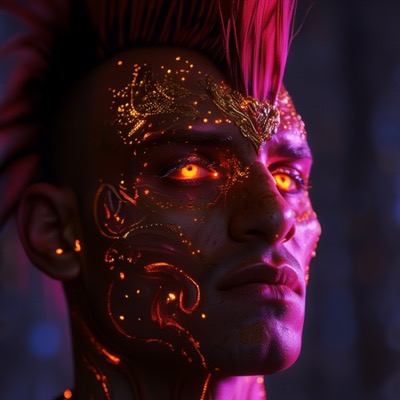
The guest
Who is BLVCKL!GHT?
BLVCKL!GHT (pronounced Blacklight) is a creative technologist from Portland, Oregon, who builds Route 47, a self-funded universe of 29 or 30 interconnected AI shows and close to 100 characters, including Gorbo's Swim Hole and Cryptid Dating Game. He makes it on top of a full-time job as VP of operations at a national marketing company, works out of the West Coast AI Labs studio in Portland, and has made five AI films over an hour long.
- Based in
- Portland, Oregon
- Known for
- Route 47, Gorbo's Swim Hole, Cryptid Dating Game, Stunt Man Stu, Mr. Gurgleson's Midnight Hour
- Studio
- West Coast AI Labs, a shared Portland studio of independent creators
- Day job
- VP of operations at a national marketing company, after 15 years in digital marketing
- Awards
- Winner at escape.ai's Escape Awards, March 2026
- Music
- Piano since age five, classically trained for ten years. Releases original house, synthwave and dreamcore tracks
YouTubeXInstagramThreadsPatreonWebsiteLinktreeFull profile →
By the numbers, per BLVCKL!GHT
Key takeaways
- 01
World building starts with rules. In Route 47, everyone has a body horror element that nobody mentions, and every character has a life beyond the show they host or appear in. Think 10,000 feet up, not episode by episode.
- 02
Distribution is the off-ramp and the replenishment stage. Self-funded at five figures a year, he hands content to Fairground, which can place it on up to five ad-supported platforms, including Roku and Amazon: five potential revenue streams, for creators willing to take an early leap of faith.
- 03
If TV is the goal, learn the box. A 30-minute slot is 22 minutes of content, almost nobody in AI is making at that length, and advertisers will pass on anything that looks too close to Game of Thrones.
- 04
Own your look. He left Midjourney about two years ago for at least 20 custom-trained LoRAs, and stacks a mood board with two style LoRAs so three datasets reinforce one style.
- 05
Match the fidelity to the story. Legend of the Void Spire was generated at 480p, upscaled to 1080 and left there, with cheap-budget acting and blocking, because 90s Saturday morning TV was never crisp.
- 06
Prove authorship by injecting yourself at every stage: your own samples and melodies, your own photography, models trained on your own art, and the edit.
- 07
You don't need millions of followers. A niche of 100,000 committed viewers who call it their show is enough, and cult classics like Rocky Horror find their audience late.
The session, narrated
Think 10,000 feet up.
Paul was away, so Chris hosted and moderated with Andrew alongside, and forgot the intro music. BLVCKL!GHT joined early in the morning from his studio in Portland, Oregon, a few weeks after Chris met him in person at Magnific's Upscale event in San Francisco. We screened three pieces and stopped after each one to ask how it was made. This is the session, narrated chapter by chapter.
Start the narrationSkip to the 15 lessons
Run of show
- 0:00Thursday's viewing, Monday's lease.
- 10:24Where does the host go after the show?
- 15:15The off-ramp that funds the next one.
- 22:58Twelve hours, minimum.
- 26:19A new model for every accident.
- 32:39Twenty-two minutes in a thirty-minute box.
- 43:07How do you portray a cheap budget?
- 1:00:50Not off my back.
- 1:04:26Where Route 47 started.
- 1:13:02Gorbo's, on Steam.
- 1:18:18Inject yourself at every step.
- 1:21:51A hundred thousand is enough.
Thursday's viewing, Monday's lease.
The August everyone expected to be quiet wasn't: Seedance 2.5 dropped and client briefs piled up. Chris had met BLVCKL!GHT at Upscale in San Francisco, Magnific's event of around 900 people. Stepping out for a cigarette, BLVCKL!GHT was swamped by six different people with cameras, and was still being interviewed half an hour later. He doesn't go to many events.
“New for me. I was like, oh, after being in my own world for so long.”
BLVCKL!GHT▶ 2:40
After a tribute to Dolly Parton, Chris asked about the studio. A friend with a studio in the same Portland building had started weekly hangouts with local creators, including PJ Ace, Tupacabra and Vnderworld. One Thursday a space opened on the top floor. By the next Monday three of them had signed the lease. It is in a rough part of town, which he sees as where culture comes from, and it is entirely self-funded.
“Trying to own your own stuff and maintain that for as long as possible has been important to me, and that's everything from content to the words that come out of my mouth.”
BLVCKL!GHT▶ 8:33
Where does the host go after the show?
Andrew asked for world building in plain terms. BLVCKL!GHT compared it to Dreams on PlayStation: you start with a flat plane, and everything is built on top of it. A world has rules that bleed into the locations, people, objects and food.
“There's like rules of the world where for me everyone has this weird body horror sort of element to it, but nobody addresses it. It's just one of the rules of this world.”
BLVCKL!GHT▶ 11:23
Then the characters. Each might have a single purpose in one show, but seen from far enough away they have whole lives. His example is the Cryptid Dating Game, a dating show where contestants try to match with cryptids.
“The host is very weird and cryptid looking himself and he's the host of that show, but he leaves the studio at the end of the day. So what's the rest of his life like?”
BLVCKL!GHT▶ 12:28
Breaking characters out of the show they live in, and letting them cross into each other's stories, is what turns a set of shows into a universe. Chris picked out the shift in thinking: set how a character behaves in the world, not just what happens in one episode. Route 47 is now 29 or 30 shows and close to 100 characters.
“If you were to take a 10,000 foot view out, they're a complex character. They have other things that they do besides like the show.”
BLVCKL!GHT▶ 12:11
The off-ramp that funds the next one.
He had just been asked to judge a festival Chris called Lumara, run by Venice, the platform with lighter restrictions on models like Seedance. For a creator making PG-13 and mature work that might be too gory for other platforms, that matters. Chris also thanked him for his articles on X, which call out companies and competitions when creators are being treated badly.
Then distribution. Fairground, which now places AI content on Roku and Amazon, approached him a couple of years ago with nothing built yet, only a vision and a team. Its CEO, Colin, had run Xumo, one of the pioneers of free ad-supported TV. BLVCKL!GHT was already on escape.ai, John Gaeta's platform, but saw more exposure there than revenue.
“It's the off-ramp and replenishment stage for any creative.”
BLVCKL!GHT▶ 18:45
Even with creative partnerships, his AI spend was five figures last year and five figures the year before. So the money from one project has to fund the next.
“When you're funding it yourself, you care about the cost and you figure out very quickly I have to distribute this.”
BLVCKL!GHT▶ 19:25
The off-ramp
How one piece of content can become five revenue streams
- 01Make it, and pay for it yourselfSelf-funded: his AI spend was five figures last year, and five figures the year before.
- 02Hand it to FairgroundAn AI distributor whose CEO, Colin, previously ran Xumo, one of the pioneers of free ad-supported TV.
- 03Out to five platformsRoku, Amazon and others: up to five ad-supported streaming platforms so far.
- 04Five potential revenue streamsEach platform is its own ad income, though this first wave is still a leap of faith on the numbers.
- 05Fund the next projectDistribution is the replenishment stage as well as the off-ramp.
From 18:45 to 21:47 in the session.
The catch is that it is a leap of faith. This is the first wave, the ad revenue and the numbers aren't there yet, and it works on trust in both directions. It isn't for anyone who needs money now. He puts out so much content that the investment made sense.
Twelve hours, minimum.
Chris told the story of escape.ai's Escape Awards, where BLVCKL!GHT won the first award of the night and missed it, asleep after a project kept him up until 4 or 5am. That is his normal pace.
“I work full-time on top of doing AI. So I'm usually doing like a minimum of 12 hour days every day.”
BLVCKL!GHT▶ 23:07
His day job is VP of operations at a national marketing company he helped build out of a garage with the owners ten years ago. He works in workflow optimisation and has been in digital marketing for 15 years, in insurance and home services, a highly regulated industry.
“There's a level of ethics standards that I have to abide by in advertising and marketing that I naturally carry over into AI.”
BLVCKL!GHT▶ 23:57
Mary in the chat asked how much of his dark, high-contrast look comes from custom models. Most of it. He has at least 20 custom-trained LoRA models, from FLUX.1 to Krea's models, and broke away from Midjourney about two years ago. It's a great exploration tool and a good gateway into AI, he says, but originality starts earlier than the prompt.
A new model for every accident.
West Coast AI Labs is not a traditional studio. Everyone is an independent creator, there is no boss, and the space is for bouncing ideas around. They had all started making Portland content when Tupacabra suggested a stuntman who gets wrecked over and over. BLVCKL!GHT took it on.
“In every episode something happens to Stu. And so the next episode has a new character model with the repercussions from the previous thing.”
BLVCKL!GHT▶ 27:11
That makes 10 or 11 character models so far, his body more affected with every one. The episode we screened starts with Stu leaving hospital.
“If I was just going through the channels and it was on TV, I wouldn't be thinking this is AI.”
Andrew Davis▶ 30:19
It was made in Seedance, and the places are real. Mary's is a strip club four blocks from the studio, open every day for 75 years, and the shots of Stu walking in match what it really looks like because BLVCKL!GHT walked over and photographed it. In another episode Stu tightrope-walks across one of Portland's steel bridges. Real photography, mixed with his characters.
Twenty-two minutes in a thirty-minute box.
Social numbers, he warned, can be gamed: his own X account is being botted, people pay for engagement, and some creators grow through agency networks. Platforms also show the same work differently. His biggest audience is on TikTok, where 8-minute 16:9 stories get huge watch numbers, against every rule of social media. On Instagram, where viewers can't flip to widescreen, engagement is far lower.
Andrew had lived this. When he left the BBC for MySpace in 2006, he found the same content that worked at the BBC could get zero views on a MySpace profile.
“Content is king is a myth. Content is king if people see it.”
Andrew Davis▶ 35:01
BLVCKL!GHT brought it back to TV. In a 30-minute slot you are making 22 minutes of content around two or three ad breaks, and only a handful of AI creators are working at that length. It takes real pacing to hold a viewer who has the TV on in the background while scrolling their phone.
“If you want to play that game, you got to get in the box.”
BLVCKL!GHT▶ 37:26
Chris admitted nothing in pure AI has held his attention past 45 minutes. BLVCKL!GHT's answers were packaging, stringing three shorts into one block with a through line like a narrator, as Tales from the Crypt and The Twilight Zone did, and nonlinear storytelling. His fifth film over an hour long, Mr. Gurgleson's Midnight Hour, is deliberately out of order, drip-feeding information so you leave with something to think about.
Chris added the budget version of the same mistake: clients arrive with 80 or 100 thousand for a project, all of it for the creative, and nothing left for distribution.
How do you portray a cheap budget?
Stu was a Portland one-off. Over the weekend before the session he had started something new: the Saturday morning cartoons he loved as a kid, brought up to 2026 with darker, more adult humour, building the lore towards a full episode.
Tim from Theoretically Media summed up the chat: 13-year-old him would love it as much as he does now. The trick was hiding in plain sight.
“All of these were generated in 480 on purpose, because it's supposed to be older footage, which isn't high fidelity.”
BLVCKL!GHT▶ 54:07
Everything was upscaled to 1080 and left there. The acting and blocking copy the cheap shows of the era too, and generating at 480p is far cheaper in credits. He trained a custom model on 90s practical-effects TV, specifically Saturday morning shows. His own childhood favourite was Zoobilee Zoo, with Ben Vereen, where performers dressed as animal characters taught children about the arts.
The Void Spire look
How to make 2026 AI look like 90s Saturday morning TV
- 01Stack three datasetsA mood board plus two style LoRAs, combined, so every layer reinforces the same style.
- 02Train for the eraA custom model of 90s practical-effects TV, specifically Saturday morning shows, with custom models in Krea for locations and characters.
- 03Generate at 480pOn purpose: it is meant to be older footage, and it costs far less in credits.
- 04Upscale to 1080, then stopIt doesn't have to be 4K. It only has to match the era.
- 05Act and block like a cheap showPerformances and staging copy the low-budget kids' shows of the time.
From 53:31 to 57:30 in the session.
The image models are custom models in Krea, for both locations and characters. Then he named the trap he is avoiding. Familiar-looking fantasy, the dragons everyone is making, is what he calls hi-fi slop: it looks great, but an advertiser who thinks it is too close to Game of Thrones won't run against it, and on ad-supported TV the advertisers approve everything.
“If an advertiser feels that that is too close to Game of Thrones and they don't want to be put up against your content, it's dead in the water.”
BLVCKL!GHT▶ 59:45
Not off my back.
A viewer asked about nodes. He says yes and no. His preference is Flora, because you work on a canvas, collaboratively, and it makes the node connections for you: name your character references and it pulls them in. For anyone who finds nodes intimidating, it teaches how a scene is built, from character sheet and location and object references to an image and then a video.
Chris had told NVIDIA something similar: agents should build node systems you can open, learn from and tweak, rather than working as black magic. Then BLVCKL!GHT gave his hot take.
“I've spent thousands of hours developing my own workflows, my own styles. I'm not giving those out to people.”
BLVCKL!GHT▶ 1:03:10
It isn't selfishness, he says. What works for him may not work for someone telling different stories. Custom workflows have real value, and the people who want them free are the ones who want to profit from them.
“I'm down for everyone being successful, but not off of my back.”
BLVCKL!GHT▶ 1:03:43
Where Route 47 started.
In December 2024 he was independent and reached out to Vnderworld and Hax, the original West Coast AI Labs founders, because their work pushed models in ways nobody else did. Together they made an AI take on Everything Is Terrible, the LA artists who mash old VHS footage into strange mixed-media films. It turned out harder than prompting, because you generate far more footage than you use and then have to make sense of it.
Gorbo's was the first custom model he made, trained on photos from his childhood trips to Florida theme parks and the 80s and 90s art he had as a kid. The park itself is based on a real swimming hole he went to growing up, which closed after a child caught a brain amoeba. Kids there had alcohol squirted in their ears when they got out of the water.
“All of this kind of came together and that's where Gorbo's Swim Hole started, and that's where Route 47 started, at Gorbo's.”
BLVCKL!GHT▶ 1:06:35
Chris paused it at the pump room to save time for the game.
Gorbo's, on Steam.
About a year ago he was approached by developers who had worked on Insomniac's Ratchet & Clank and on Subway Surfers. In January they pivoted, and what they were building overlapped with Route 47. The game will be on Steam and starts with Gorbo's Swim Hole: a multiplayer, open-world experience where you visit the park and try the rides. He has weekly calls with the team and provides all the assets, while they do the game development.
Chris asked how Steam feels about generative assets. The chain matters. Route 47's assets start with his own images, photography and art, which trained a model, which made images, which become 3D assets that are hand-built into the map.
“The AI part of the process is so small in comparison to the work that's being done around building the game itself.”
BLVCKL!GHT▶ 1:17:38
His profile has said creating generative experiences for a long time. He sees himself as one of the experience builders whose worlds people will walk into.
Inject yourself at every step.
Chris raised the grey areas: when AI has to be declared, and what counts as generative music. BLVCKL!GHT's answer is human authorship, and he comes at it as a musician. He has played piano since he was five and was classically trained for ten years, and music is how he got into all of this, with years of his own samples, ditties and recordings.
“Human authorship is always going to be the thing that you have to prove, and the more tools that you stack on top of that, the more of a house of cards it kind of becomes.”
BLVCKL!GHT▶ 1:19:32
Proving human authorship
Where BLVCKL!GHT puts himself into a single project
- 01The samplesHe makes them himself. AI may help with the music, but the rhythm, melody and soundtrack are his.
- 02The photographyHis own photos and images, from Portland locations to childhood theme parks.
- 03The modelsCustom models trained on his own art and photography.
- 04The animationThis is where AI may generate the movement.
- 05The editThe edit alone is another point where he is the decision maker.
The more points where you are the originator, the easier it is to explain later. From 1:19:41 to 1:20:29 in the session.
Chris pointed out how well musicians have moved into AI. They already know DAWs, and he finds the best marketers are often music heads too.
A hundred thousand is enough.
“I'm not a Gossip Goblin, right? I don't have a team of people and voice actors and backing and all of these things.”
BLVCKL!GHT▶ 1:22:03
His point is that one person can bring their own art and find their people. His biggest audiences, on TikTok and elsewhere, are addicted to the content, and talk about it as their show.
“When people claim their show is on, you don't own it anymore.”
BLVCKL!GHT▶ 1:22:48
It doesn't need millions. A hundred thousand people who show up can be all it takes. And cult classics last: Rocky Horror was a box office flop that Tim Curry was embarrassed by, until midnight screenings made it iconic. Andrew added Fight Club, Scarface and Money Heist, which ran two seasons on a Spanish channel before Netflix picked it up.
Chris noted that streamers like Amazon Prime and Roku now want AI content the way Netflix once wanted any content, and will need quality control. Fairground is already selective.
The quality bar
Fairground submissions versus creators showcased
BLVCKL!GHT's figures at 1:27:18, given as approximate. The second bar uses 200 as a stand-in for fewer than 200.
His feedback to Fairground was to give creators the rules of the box: the time slots, the themes, what people want to watch and how engagement looks. Feedback loops, so creators build towards something instead of constantly market testing. His last advice, for students and newcomers, was to pick one platform that does everything, like Krea or Magnific, and not to rush. Mr. Gurgleson's Midnight Hour is on his YouTube channel now.
“Don't feel rushed. Don't feel overwhelmed. There's a lot of pieces to it. And don't learn something new until you need it.”
BLVCKL!GHT▶ 1:30:48
The lesson ledger
15 lessons from 92 minutes with BLVCKL!GHT.
Every lesson is pinned to the moment it was said. Each one ends with something you can do this week.
-
01Story
Set rules your world never explains
“There's like rules of the world where for me everyone has this weird body horror sort of element to it, but nobody addresses it.”BLVCKL!GHT ▶ 11:23
Try thisWrite three rules your world runs on that differ from reality. Make sure no character ever comments on them.
-
02Story
Give every character a life outside their show
“If you were to take a 10,000 foot view out, they're a complex character. They have other things that they do besides like the show.”BLVCKL!GHT ▶ 12:11
Try thisPick your most minor recurring character and write what they do after work. Use it in a scene in a different show.
-
03Business
Treat distribution as the off-ramp
“It's the off-ramp and replenishment stage for any creative.”BLVCKL!GHT ▶ 18:45
Try thisBefore you start your next project, name where it will be distributed and how its earnings will fund the one after.
-
04Craft
Make your own look from the start
“If you want to genuinely be original, it starts at the beginning. You got to make your own look and your own feel.”BLVCKL!GHT ▶ 25:21
Try thisGather 20 to 30 of your own images in one style and train your first custom LoRA on them.
-
05Workflow
Carry the damage into the next character model
“In every episode something happens to Stu. And so the next episode has a new character model with the repercussions from the previous thing.”BLVCKL!GHT ▶ 27:11
Try thisVersion your character sheets by episode. After every scene that changes a character, make the next sheet before you generate again.
-
06Craft
Photograph real places
“I'm taking like real photos and mixing them with my characters and trying to tell stories with it.”BLVCKL!GHT ▶ 31:23
Try thisWalk your own neighbourhood with a camera and use three real locations as references in your next short.
-
07Mindset
Metrics aren't your guiding light
“You can't really rely on those metrics as your guiding light for success. You need to show it to people and see how they feel about it.”BLVCKL!GHT ▶ 33:28
Try thisShow your next piece to five real people before you post it, and write down what they say before you look at any numbers.
-
08Business
Write for 22 minutes, not 30
“On a TV audience for a 30 minute block, you're really making 22 minutes of content.”BLVCKL!GHT ▶ 35:58
Try thisIf you want TV, outline your next episode at 22 minutes with two or three natural ad breaks.
-
09Story
Tell it out of order
“I'm really big on nonlinear storytelling, one because that's the way that we recall memory, it's not linear.”BLVCKL!GHT ▶ 39:56
Try thisTake a finished short and re-edit it out of order so the audience has to piece it together. Keep the version that leaves more to think about.
-
10Craft
Generate at the fidelity of the era
“All of these were generated in 480 on purpose, because it's supposed to be older footage, which isn't high fidelity.”BLVCKL!GHT ▶ 54:07
Try thisFor any retro piece, generate at 480p, upscale once to 1080 and stop. Spend the credits you save on more takes.
-
11Workflow
Stack datasets to reinforce a style
“It's its own mood board plus two style LoRAs combined. So all in all there's three custom data sets working together to create the imagery for this.”BLVCKL!GHT ▶ 57:13
Try thisFor your next series, build a mood board and two style LoRAs and run them together, so every generation is pulled towards the same look.
-
12Business
Stay away from hi-fi slop
“If an advertiser feels that that is too close to Game of Thrones and they don't want to be put up against your content, it's dead in the water.”BLVCKL!GHT ▶ 59:45
Try thisList the three most familiar things in your project, like dragons or castles, and redesign each until it couldn't be mistaken for a famous IP.
-
13Workflow
Learn nodes on a canvas that builds them for you
“If you're unfamiliar with how to set up nodes, something like Flora is very helpful because it helps you think about the technical aspect of how a scene is built.”BLVCKL!GHT ▶ 1:01:33
Try thisBuild one scene in a node canvas: character sheet, location and object references, then image, then video. Keep it as your template.
-
14Business
Be the decision maker at every step
“If you can point to where you were the decision maker, the creator, the originator in multiple steps along that process, the easier it is to prove.”BLVCKL!GHT ▶ 1:19:41
Try thisFor your next project, keep a log of each step where you made the original material: samples, photos, training data, the edit.
-
15Mindset
Don't learn it until you need it
“Don't learn something new until you need it.”BLVCKL!GHT ▶ 1:30:53
Try thisPick one all-in-one platform and finish a project in it. Only add a new tool when the project can't move without it.
The toolkit, in BLVCKL!GHT's words
- Kreacore
Where he trains custom image models for locations and characters, including Legend of the Void Spire. He recommends it as a starting point.
▶ 56:45 - Seedancecore
The video model behind Stu Needs A Dollar.
▶ 30:44 - FLUX.1uses
One of the bases for his 20-plus custom-trained LoRAs.
▶ 24:50 - Florapreferred
His preferred node system: a collaborative canvas that makes the node connections for you.
▶ 1:01:10 - Veniceworkaround
Lighter restrictions when other platforms block gory or visceral PG-13 and mature generations.
▶ 15:59 - Magnificrecommends
With Krea, his pick for newcomers who want one platform that does everything.
▶ 1:30:36 - Midjourneydropped
Left about two years ago. A great exploration tool and gateway, but not the way to an original look.
▶ 25:08
On the record
“If you were to take a 10,000 foot view out, they're a complex character. They have other things that they do besides like the show.”
“When you're funding it yourself, you care about the cost.”
“Content is king is a myth. Content is king if people see it.”
“If you want to play that game, you got to get in the box.”
“I'm down for everyone being successful, but not off of my back.”
“Human authorship is always going to be the thing that you have to prove.”
“When people claim their show is on, you don't own it anymore.”
“Don't learn something new until you need it.”
Quotes are trimmed of filler words for reading. Every timestamp opens the session at that moment.
Chapters
- 0:00No Paul, a busy August, and no intro music
- 1:09Meeting at Upscale, and getting swarmed
- 6:47Bootstrapping the studio and signing the lease
- 10:24What does world building actually mean?
- 12:03Characters with lives outside their own show
- 14:46Route 47: 30 shows, 100 characters
- 15:15Judging the Lumara festival, and writing on X
- 18:11Fairground, Roku and the distribution off-ramp
- 22:58The 12-hour days and the full-time job
- 24:35Twenty custom LoRAs, and leaving Midjourney behind
- 26:19Setting up Stu Needs A Dollar
- 27:49STU NEEDS A DOLLAR
- 30:02Real Portland locations, real photography
- 32:39Why can't social metrics be your guiding light?
- 33:48Is content king a myth?
- 35:58Why 30 minutes of TV is 22 minutes of content
- 38:01The 45-minute attention problem
- 39:38Packaging shorts, and nonlinear storytelling
- 43:07What's next in the Route 47 world?
- 45:34LEGEND OF THE VOID SPIRE
- 53:31Why generate at 480p on purpose?
- 55:17Saturday morning cartoons, and Zoobilee Zoo
- 56:36Three custom datasets in one look
- 59:23What is hi-fi slop?
- 1:00:50Nodes, and why Flora is the way in
- 1:03:01Why he won't hand out his workflows
- 1:04:34The story behind Gorbo's Swim Hole
- 1:07:43GORBO'S SWIM HOLE
- 1:13:02The Route 47 game coming to Steam
- 1:17:02How does Steam feel about generative assets?
- 1:18:18How do you prove human authorship?
- 1:21:51Why you don't need millions of followers
- 1:23:45Rocky Horror, Fight Club and the cult classic argument
- 1:26:52What should distributors be telling creators?
- 1:30:19Advice for students and newcomers
Questions this session answers
Who is BLVCKL!GHT?
BLVCKL!GHT (pronounced Blacklight) is a creative technologist based in Portland, Oregon, who builds Route 47, a self-funded universe of 29 or 30 AI shows and close to 100 characters. He makes it on top of a full-time job as VP of operations at a national marketing company, after 15 years in digital marketing, and works from the West Coast AI Labs studio in Portland.
What is Route 47?
Route 47 is BLVCKL!GHT's interconnected AI universe: 29 or 30 separate shows and around 100 characters in one world, including Gorbo's Swim Hole and Cryptid Dating Game. Every character has a life outside the show they appear in, and the world has its own rules, like a body horror element that nobody ever mentions.
What is Gorbo's Swim Hole?
Gorbo's Swim Hole is the strange AI water park where Route 47 began. BLVCKL!GHT built it from his first custom model, trained on his childhood photos from Florida theme parks and 80s and 90s art, and based it on a real swimming hole he visited as a kid. It grew out of a December 2024 collaboration with Vnderworld and Hax, and is now being made into a multiplayer game for Steam.
What AI tools does BLVCKL!GHT use?
He trains his own models: at least 20 custom LoRAs, on bases from FLUX.1 to Krea's models, with custom models in Krea for characters and locations. He made Stu Needs A Dollar in Seedance, uses Venice when other platforms block mature content, and prefers Flora for node workflows. He left Midjourney about two years ago.
How did BLVCKL!GHT make Legend of the Void Spire look like a 90s TV show?
He generated every shot at 480p on purpose, upscaled to 1080 and left it there, and staged the acting and blocking like a cheap Saturday morning show. The look comes from a custom model of 90s practical-effects TV, plus a mood board and two style LoRAs: three custom datasets working together.
How do AI creators get their shows onto Roku?
BLVCKL!GHT distributes through Fairground, an AI content distributor run by Colin, the former CEO of Xumo. Fairground can place one piece of content on up to five ad-supported streaming platforms, including Roku and Amazon, which he sees as five potential revenue streams. It received more than 2,000 submissions and is showcasing fewer than 200 creators.
How long should an AI TV episode be?
For a 30-minute TV slot, BLVCKL!GHT says you are really making 22 minutes of content, leaving room for two or three ad breaks. He says only a handful of AI creators are making work at that length.
How do you prove human authorship of AI work?
BLVCKL!GHT's approach is to be the originator at as many steps as possible: making his own music samples, rhythm and melody, shooting his own photography, training models on his own art, and doing the edit. The more points where you inject yourself, he says, the easier it is to prove later.
Is there a Route 47 game?
Yes. A team of developers who worked on Ratchet & Clank and Subway Surfers is building a Route 47 game for Steam, starting with Gorbo's Swim Hole. It will be a multiplayer, open-world experience where players visit the park and its rides, with BLVCKL!GHT providing the assets.
New Creator Sessions every Wednesday
Long-form conversations with the best AI creators in the world, screening their work live. Tuesdays we review the week's best AI work and you vote.